
Industrial Facade Systems
Aluminium Cladding Engineered Before Installation
SIPANEL coordinates panel layout, substructure, joints, flashings, edge details, and thermal movement before installation begins to reduce facade risk.
Technical review for industrial facade systems, substructure details, and controlled installation.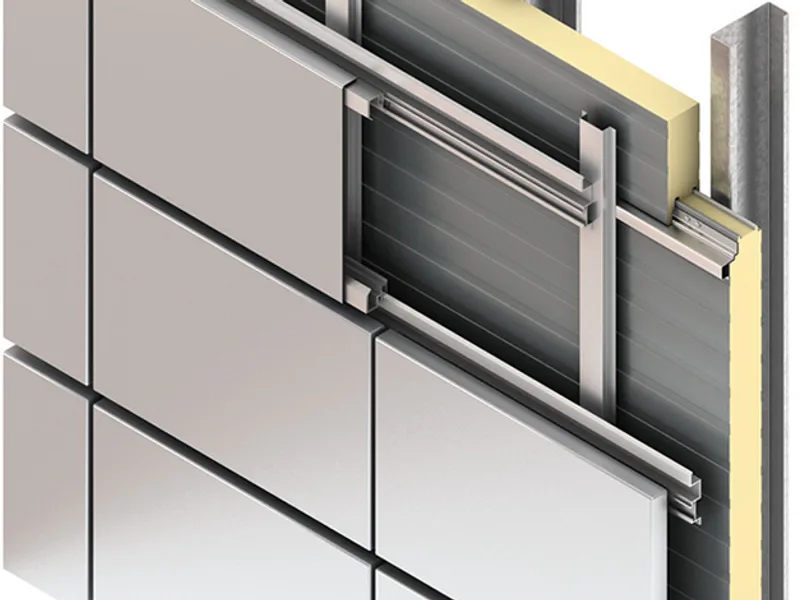
Facade Problems Usually Start with Poor Coordination
Poor substructure coordination: misalignment between substructure and panel layout causes rework, delays, and visual defects on the finished facade
Panel alignment and flatness issues: without precise substructure control and installation discipline, the facade surface appears uneven and inconsistent
Joint and sealant failures: unplanned joints and incorrect sealant application lead to water ingress and long-term maintenance problems
Edge, corner, and flashing detailing problems: without precise pre-installation details, edges and corners become weak points on the facade
Thermal movement and installation sequence errors: large facade surfaces need movement-aware detailing and a controlled installation sequence — without this coordination, even good materials fail
Related Facade Projects
Results from real projects executed with SIPANEL engineering coordination.

Shahr Babak Stadium Entrance
Shahr Babak, Kerman, Iran — 700 m²
- Challenge
- Curved stadium entrance requiring precise aluminium cladding detailing with complex geometry and substructure-panel coordination.
- Result
- Visually distinctive aluminium-clad stadium entrance delivered with controlled quality.

Parand City Entrance Gate
Parand, Tehran, Iran — 500 m²
- Challenge
- Special architectural city entrance requiring customized aluminium cladding with precise geometry, substructure, and panel coordination.
- Result
- Distinctive aluminium-clad city entrance gate delivered with controlled quality.

Erbil Eye Hospital Entrance Canopy
Erbil, Kurdistan Region, Iraq — 1,500 m²
- Challenge
- Translating the symbolic eye-shaped architectural concept into a buildable structure while preserving visual identity and coordinating structure, panels, and substructure.
- Result
- Successful completion of 1,500 m² entrance canopy preserving the eye-shaped identity with controlled quality.
How SIPANEL Engineers Facade Risk Before Execution
Shop Drawing Coordination
Panel layout, joint patterns, edge details, substructure connections, and installation sequence are documented before procurement.
BOM & Material Planning
Panels, substructure profiles, fasteners, flashings, sealants, and accessories are planned to reduce waste and site delays.
Installation Planning
Installation sequence, alignment control, joint tolerance, and inspection checkpoints are defined before site work begins.
Quality Control
Panel flatness, joint alignment, flashing positions, sealant lines, and edge details are inspected at defined checkpoints.
Independent Facade System Recommendations
SIPANEL operates as a facade system engineer, not a panel reseller. System selection is based on project conditions, not warehouse inventory.
Project-First Facade Selection
Panel type, substructure system, joint pattern, and edge details are reviewed based on building geometry, climate conditions, and project requirements.
Procurement Planning Support
Panel quantities, substructure profiles, flashings, and accessories are coordinated with shop drawings to reduce shortages and site delays.
Installation Risk Coordination
Installation sequence, alignment control, and quality checkpoints are reviewed and defined before site work begins.
Typical Facade Installation
- Panel selected before substructure review
- Joint and edge decisions made on site
- Flashings handled reactively
- Accessories missing or delayed
- Quality depends on installer habit
SIPANEL Engineering Approach
- Facade geometry and substructure reviewed early
- Joints and edge details coordinated before installation
- Flashings detailed as part of the system
- Accessories planned before procurement
- Execution follows checkpoints and technical control
Where Aluminium Cladding Fits
Engineering Proof Before Installation

Shop Drawing
Panel layout, joint patterns, and connection details coordinated before procurement.

Waterproofing / Flashing Detail
Flashing, joint sealing, and edge connection details reviewed before installation.

BOM / Material Takeoff
Panel, substructure, flashing, and accessory quantities coordinated with shop drawings.
Facade Quality Checkpoints
- Substructure alignment and flatness verification
- Panel layout and joint alignment control
- Flashing, edge, and corner detail review
- Sealant line and joint waterproofing check
- Thermal movement and connection detail verification
- Final surface flatness and visual uniformity inspection
Aluminium Cladding Questions
Why is aluminium cladding suitable for industrial and commercial projects?
Aluminium cladding offers lightweight construction, durability, corrosion resistance, and design flexibility — when substructure, panel layout, joints, and edge details are engineered correctly.
What causes most aluminium cladding problems?
Problems typically start from poor substructure coordination, panel misalignment, joint and sealant failures, incomplete edge and corner details, or installation sequence errors.
Does SIPANEL review substructure before installation?
Yes. Substructure alignment, connections, panel layout, joint patterns, and edge details are reviewed before installation planning begins.
What is the difference between supply-only cladding and engineered cladding?
Supply-only focuses on panel delivery. Engineered cladding coordinates the complete facade system — including substructure, details, procurement, installation sequence, and quality checkpoints.
Does SIPANEL provide facade shop drawings?
Yes. Panel layout, joint patterns, edge details, substructure connections, and installation sequence are documented in shop drawings before procurement.
How is thermal movement managed on large facades?
Expansion joints, sliding connections, and movement-aware detailing are defined in shop drawings to control thermal stress across large facade surfaces.
How is joint waterproofing controlled on the facade?
Sealant type, joint width, backer rod depth, and sealant application sequence are reviewed and defined before installation to reduce water ingress risk.
Is SIPANEL a supplier only or does it also handle installation?
SIPANEL provides engineering-controlled execution — from facade geometry review and shop drawings to procurement coordination and controlled installation with quality checkpoints.
Review the Facade Risk Before Installation Starts
Request a technical facade review for substructure, panel layout, joints, and controlled installation planning.